Late 15th century
Chapter 1 of 15 · Built for trade Approved by WMA
The Tait family build a stone townhouse
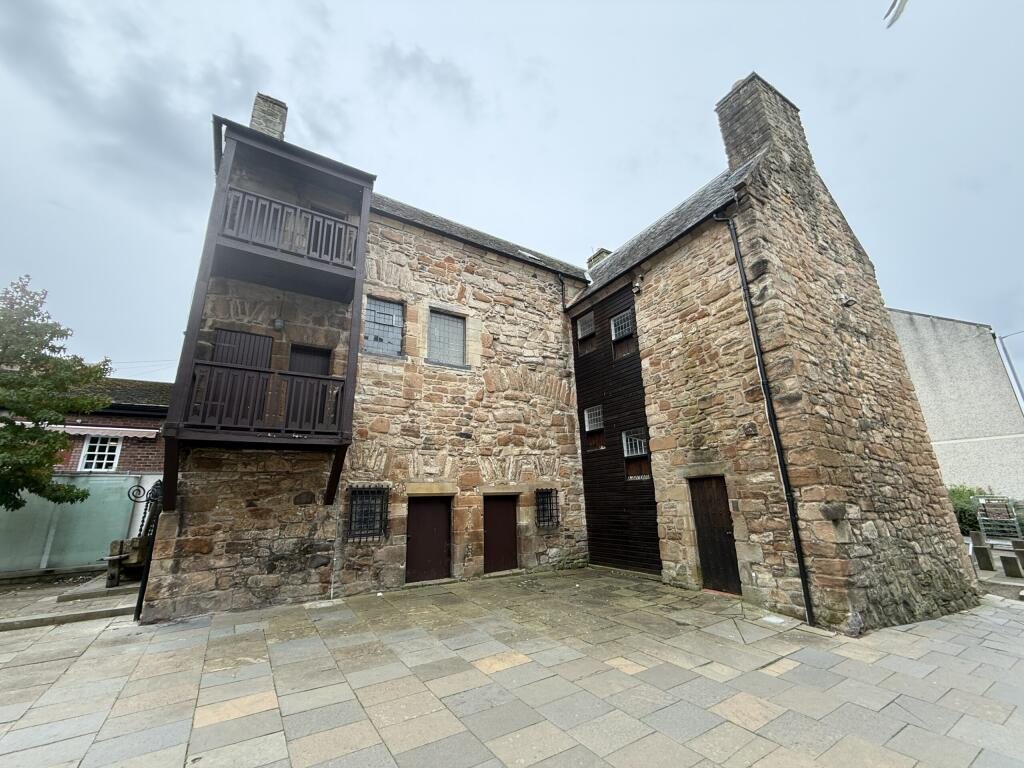
Loudoun Hall was built in the late 15th century for the Tait family, merchants and burgesses of Ayr. It is first recorded in 1517 as the home of James Tait. A burgess was a freeman of the town with the right to trade.
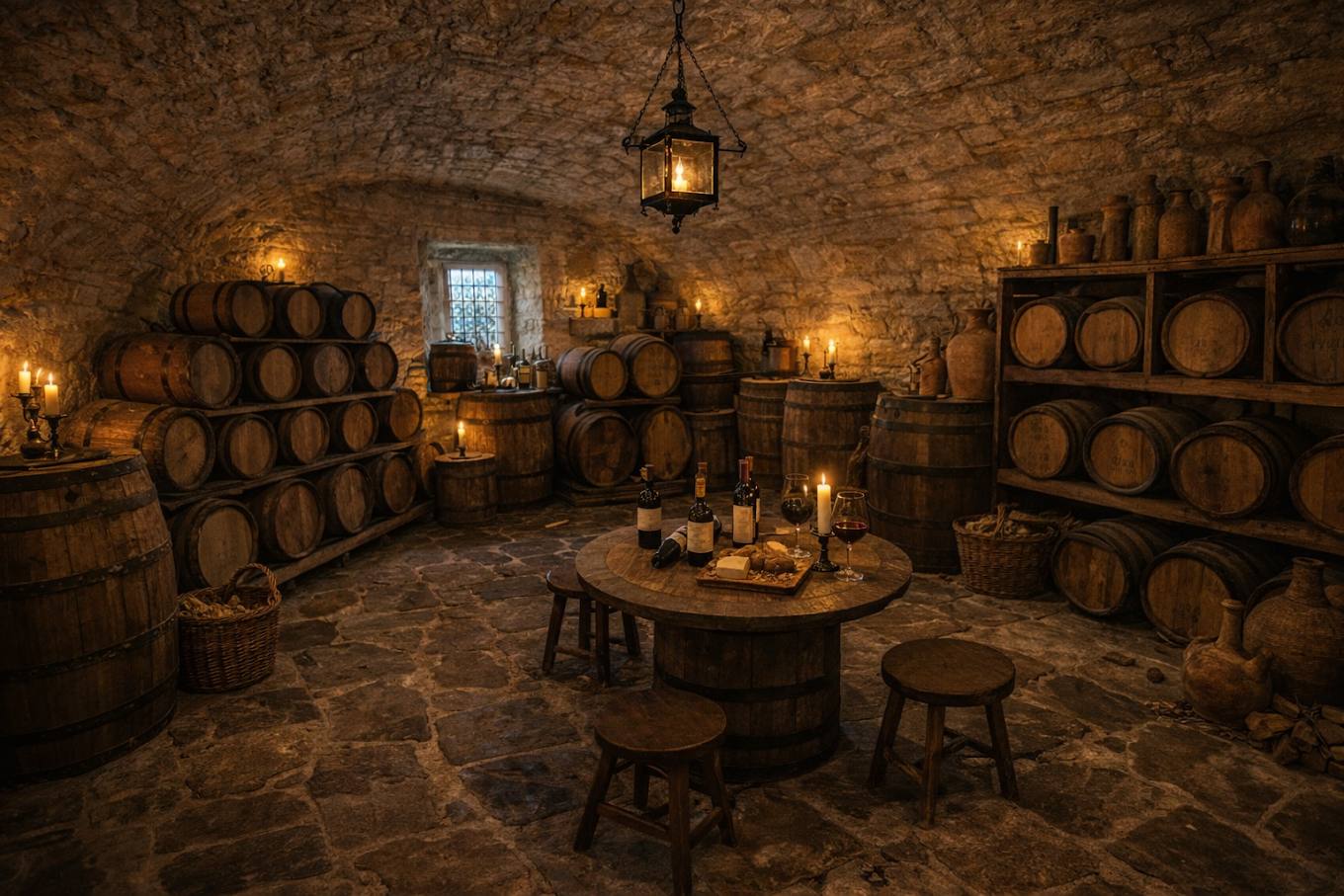
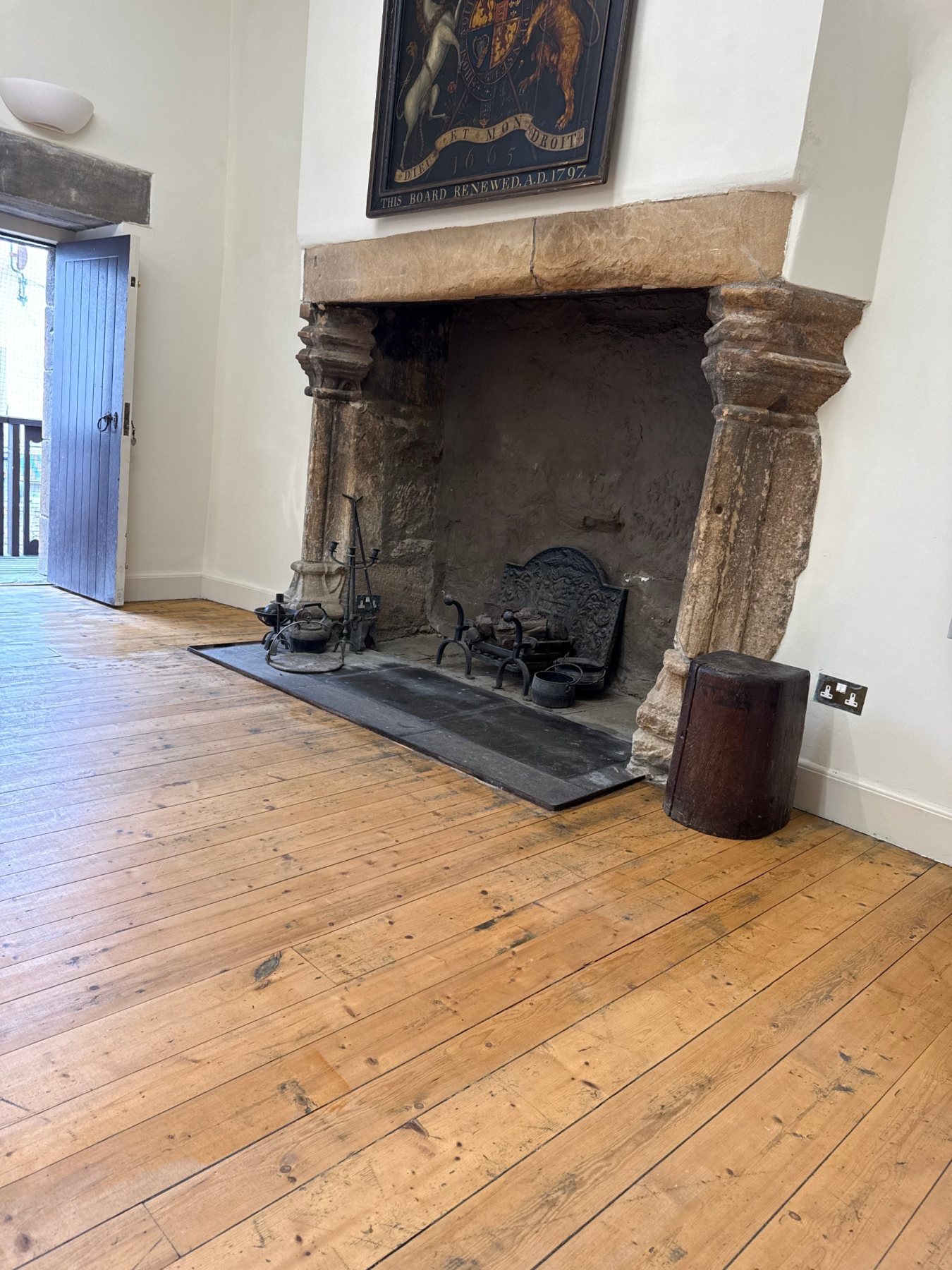
It began as an oblong house of three storeys: vaulted cellars for goods, a great hall above, and bedrooms at the top. A narrow stair led from the wine cellar straight up to the hall.
It stood on the Boat Vennel, then the main street between the town and the harbour, so the town's trade passed the merchant's door.
Review noteWMA chose "late 15th century" (29 October). Supported by Close and Fergusson. Historic Environment Scotland gives c.1513.
Sources: Close 2025, Fergusson 1950.
1528–39
Chapter 2 of 15 · The Loudoun name Sourced
The Sheriff of Ayr moves in
Sir Hugh Campbell of Loudoun, hereditary Sheriff of Ayr, bought the house from James Tait sometime between 1528 and 1539.
He had been a turbulent young man, outlawed in 1527 for ordering the killing of the Earl of Cassillis, so he could not have bought it before the sentence was lifted in July 1528.
A north wing was added towards the harbour, giving the house its L shape. Historic Environment Scotland dates it to 1534. The Campbells gave the house the name it still carries.
Review noteClose suggests the wing may date from 1539. The official 1534 date is used.
Sources: Historic Environment Scotland, Fergusson 1950, Close 2025.
1530s–1622
Chapter 3 of 15 · The Sheriff's lodging New or corrected
Wine and sweets for the Sheriff
For three generations this was the Sheriff's house: Sir Hugh, his son Sir Matthew, then his grandson, another Sir Hugh. In their day it was known simply as "the Sheriff's lodging".
The town kept its Sheriffs sweet. The burgh accounts record gifts of wine and boxes of "confeittis", or sweets, such as six quarts of wine for the Sheriff's April court in 1597.
In February 1596 Provost David Fergushill signed a deed "within the yard of the lugeing of Hew Campbell of Loudoun", in the Hall's own garden. At least four members of the old Scots Parliament lived here over the years.
Review noteNew chapter from Fergusson and Close.
Sources: Fergusson 1950, Close 2025.
1563
Chapter 4 of 15 · A royal guest Approved by WMA
The Queen stays at Loudoun Hall
In early August 1563 Mary Queen of Scots spent two nights in Ayr, on a royal progress through the west of Scotland. She was twenty years old.
She stayed here, at Loudoun Hall, as the guest of Sir Matthew Campbell, Sheriff of Ayr and one of her firmest supporters. It was his town house, and probably the best-appointed house in the burgh.
Review noteWMA's stance (Brian, 29 October): she stayed here. Stated plainly, with one honest line noting that no record names the house.
Sources: South Ayrshire Council, Loudoun Hall history page, 2013 article, Fergusson 1950.
1563–1658
Chapter 5 of 15 · A darker chapter New or corrected
Fear of witchcraft in Ayr
Scotland's Witchcraft Act of 1563 made witchcraft a crime punishable by death. The Sheriffs who lived here were among the most powerful figures in Ayrshire's system of justice.
In 1658 Janet Sawer, a married woman of Ayr who had been held since 1651, was tried at the town's Tolbooth and found guilty. On 23 April she was strangled and burned.
Outside the Hall, a lead circle in the courtyard paving marks the reputed spot where Ayr's first witch was burned.
Review noteNew chapter from WMA's article, checked against the Survey of Scottish Witchcraft and Gordon Young's own record of the courtyard.
Sources: Survey of Scottish Witchcraft, Gordon Young, WMA Group.
1622–66
Chapter 6 of 15 · Crown & politics New or corrected
A Sheriff's office sold to the King
When the last Campbell Sheriff died in 1622, the office passed to Sir John Campbell of Lawers, later Earl of Loudoun. In 1634 he sold the Sheriffship to King Charles I for 14,000 merks.
The new Sheriff, James Chalmer of Gadgirth, also became owner of the Hall. He sat in the Scots Parliament of 1628 to 1633.
In 1652 Cromwell's huge fort rose barely 100 yards away, quite overshadowing the old house.
Review noteCorrected. The earlier demo said the house was sold to the Crown in 1622. Fergusson shows it was the office of Sheriff, sold in 1634.
Sources: Fergusson 1950, Close 2025.
1638–1688
Chapter 7 of 15 · Faith & defiance New or corrected
The Covenanters
In 1638 thousands of Scots signed the National Covenant to defend their Presbyterian Kirk against King Charles I. James Chalmer of Gadgirth, owner of Loudoun Hall, took part in the peace talks with the King that began at Ripon in 1640.
After 1660, ministers who refused to conform preached at secret meetings called conventicles. On 27 December 1666, seven Covenanters captured at Rullion Green were hanged in Ayr, a short walk from the Hall.
In 1678 the Hall's owner, former Provost John Muir, was accused of "several conventicles and other great disorders". Secret preaching is said to have taken place in his own home. Whether that was Loudoun Hall is one of the building's mysteries.
Review noteNew chapter from WMA's article. The Ayr martyrs and the 1678 accusation are checked. The account of John Welwood preaching in Muir's home (deposition of 22 February 1678) still needs its source.
Sources: WMA Group, Highland Host records, 1678, Ayr Martyrs records, Fergusson 1950.
1666–1770
Chapter 8 of 15 · Provosts & trade Approved by WMA
The Muirs, merchants and Provosts
In 1666 John Chalmer sold the house to John Muir of Park, an Ayr merchant. Pursued by the government in 1678 for his support of the Covenanters, he returned after 1688 as Provost, and sat in the Scots Parliament from 1689 to 1707.
In 1684 he handed it to his son Robert, also Provost and a member of Parliament. For a generation the Muirs had, as one writer put it, "the whole sway and mastery of the town".
Provost Robert Muir traded with France for wine and with Virginia for tobacco, and grew rich.
Review noteJohn Muir, as WMA's Covenanters article says. The 1678 government record, the Parliament roll and the 1666 title deed all say John. Fergusson and Close say James, which looks like a slip. The tobacco line follows WMA's choice (leave it out).
Sources: Fergusson 1950, Close 2025, Highland Host records, 1678, Parliaments of Scotland.
1660s–1700s
Chapter 9 of 15 · Contraband New or corrected
Smugglers and the secrets of the harbour
John Muir was a partner in a group of Ayr merchants trading across the Atlantic. English law barred Scots from trading with England's colonies, so they brought West Indian tobacco home on a ship disguised as English-owned.
After the Union of 1707, high duties made smuggling hugely profitable. Tobacco, brandy, wine, tea and silk came ashore along the Ayrshire coast, and the caves beneath Culzean Castle became a smugglers' lair.
Tales of hidden tunnels and secret stores beneath the old town are still part of Ayr's folklore.
Review noteNew chapter from WMA's article, checked against South Ayrshire Council and the National Trust for Scotland. The tunnels are kept clearly as folklore.
Sources: South Ayrshire Council, Loudoun Hall history page, National Trust for Scotland, WMA Group.
1770–1936
Chapter 10 of 15 · Forgotten New or corrected
From fine house to crowded tenement
New streets and a new bridge took the traffic away from the Boat Vennel, and the well-off moved to new houses such as those around Wellington Square.
In 1770 Dr Robert Muir, then living in London, sold the house to Daniel Bruce, a fisherman, for £61 1s. A tall stair tower was squeezed into the corner and the house was divided up, home over the years to shipmasters, an innkeeper, a stocking-maker and a ship's carpenter.
By 1903, when typhus broke out, five families lived inside. In 1936 the house was included in the Boat Vennel Clearance Order, marked for demolition.
Review noteNew chapter from Fergusson and Close.
Sources: Fergusson 1950, Close 2025.
1937–56
Chapter 11 of 15 · Rescued New or corrected
Saved from demolition and restored
The Rev. Archibald Mackenzie of the Auld Kirk persuaded the owner to hand the building over. He owned it for two days, then passed it to John Crichton-Stuart, 4th Marquess of Bute (1881 to 1947), who began restoring it at his own expense. The war halted the work, and the Marquess died in 1947 before it was finished.
After the war the council's Housing Committee again recommended demolition, by a single vote. In October 1947, with the Saltire Society offering to restore it, the full council reversed the decision. His son, Lord David Stuart, gave the Hall to three trustees nominated by the Saltire Society.
Architect Robert Hurd gave his services free. His new staircase used an oak stair from Culzean Castle, made from the timbers of the Marquess of Ailsa's yacht. The Hall formally reopened on 26 September 1956.
Review noteExpanded from Fergusson and Close. The yacht detail is from Fergusson.
Sources: Historic Environment Scotland, Fergusson 1950, Close 2025, WMA Group.
1960s–70s
Chapter 12 of 15 · Folk nights Sourced
Ayr Folk Club fills the Hall with music
After restoration the Hall became a home for Ayr's clubs and societies, and for Ayr Folk Club during the town's lively folk scene.
Destination South Ayrshire records performers including Pete and Peggy Seeger, and Billy Connolly, then with The Humblebums.
Sources: Destination South Ayrshire, Close 2025.
1980
Chapter 13 of 15 · Protected Sourced
Category A listed
Loudoun Hall was listed Category A on 10 January 1980, the highest protection for a historic building in Scotland.
Historic Environment Scotland describes it as an outstanding example of Scotland's few surviving pieces of 16th-century burgh architecture.
Sources: Historic Environment Scotland.
1990s–2019
Chapter 14 of 15 · A home for Ayr New or corrected
Clubs, concerts and a quiet spell
From 1968 the council leased the Hall from its trustees. It hosted Ayr's photographers, chess players, archaeologists and civic society, along with music, theatre, art shows and weddings.
The courtyard was redesigned in 1995 to 1997, and in 1997 to 1998 a new stair opened up the upper floor.
From October 2019 the council stopped letting the Hall, and it fell quiet.
Review noteNew chapter from Close.
Sources: Close 2025, Historic Environment Scotland.
2026
Chapter 15 of 15 · A new chapter Approved by WMA
WMA Group becomes the new custodian
In August 2026, WMA Group Ltd became the proud owners of Loudoun Hall, one of Ayr's oldest and most historically significant buildings. Recognising both its remarkable heritage and its untapped potential, WMA Group acquired the property from the Loudoun Hall trustees with a commitment to safeguarding its future.
Our vision is to breathe new life into this extraordinary building, carefully preserving its historic character while creating a welcoming venue for weddings, celebrations, cultural events and community activities.
By giving Loudoun Hall a sustainable new purpose, we hope to ensure that this important part of Ayr's heritage can be enjoyed and appreciated for generations to come.
Review noteBrian's own words, 29 October 2026.
Sources: WMA Group.